

Definition:
B2B SaaS (Business-to-Business Software as a Service) is cloud-based software delivered via a subscription model to other businesses, designed to solve operational challenges and improve efficiency.
If you are exploring software, startups, or modern business tools, you have likely encountered the term “B2B SaaS”. While it sounds technical, the concept is straightforward: it is the backbone of how modern companies operate.
In fact, businesses rely on B2B SaaS daily for everything from team communication and project management to customer relationship management and financial operations. This guide breaks down exactly what B2B SaaS is, how it works, and why it is essential for growth in 2026.
Learn About: What Is SaaS Sales? & How to Scale a SaaS Business!
What is B2B SaaS?
B2B SaaS stands for Business-to-Business Software as a Service. It is a software licensing and delivery model where a company provides access to its software to other businesses over the internet, typically through a recurring subscription.
In simple words: B2B SaaS is cloud-based software that helps other businesses run their operations more effectively.
Unlike traditional software, there is no physical installation. Users simply create an account, log in via a web browser or mobile app, and begin using the service.
Learn About: Common SaaS SEO Mistakes & Common UX Mistakes That Kill Conversion!
A Quick Example to Understand It Better
Think of it like this:
Years ago, businesses had to buy software CDs, install them, and manually update everything. Today, tools like Slack or HubSpot work completely online.
You just:
- Sign up
- Log in
- Start using
No installation. No maintenance. That’s B2B SaaS.
Learn About: How to Choose a SaaS Development Partner in 2026
How Does B2B SaaS Work?
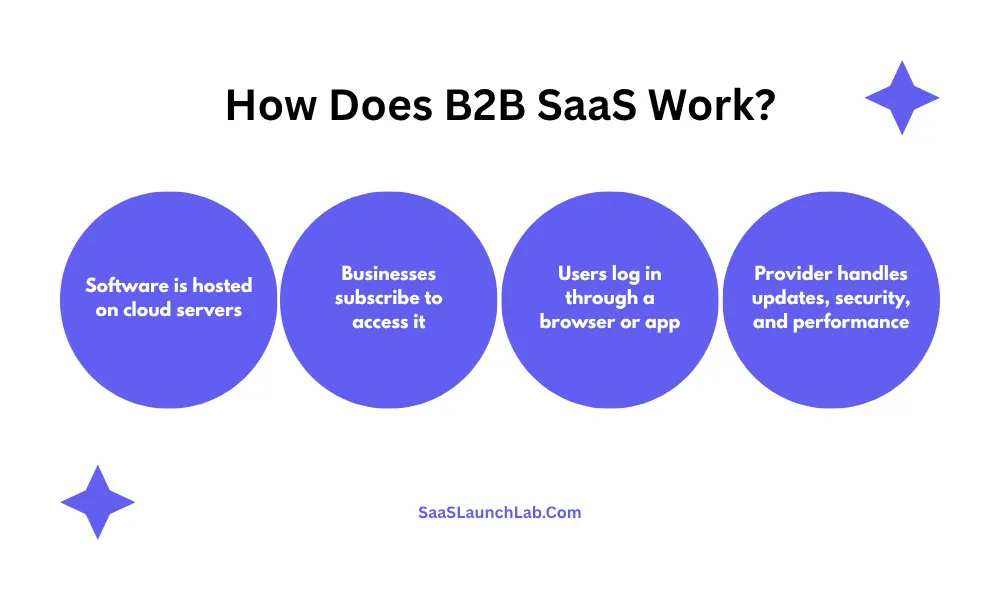
The B2B SaaS model operates on a few core principles that make it efficient for both the provider and the business customer:
- Cloud Hosting: The software application is hosted and maintained on the provider’s cloud servers, not on the user’s local computers.
- Subscription Access: Businesses pay a recurring fee (monthly or yearly) to use the software. This is often based on the number of users or features needed.
- Universal Access: Users can access the software from anywhere with an internet connection, using any device.
- The SaaS provider handles all technical aspects: updates, security, server maintenance, and performance optimization.
This model allows companies to focus on their core business goals without the overhead of managing complex software infrastructure.
Learn About: How to Validate a SaaS Idea Before Spending $1
Popular B2B SaaS Examples
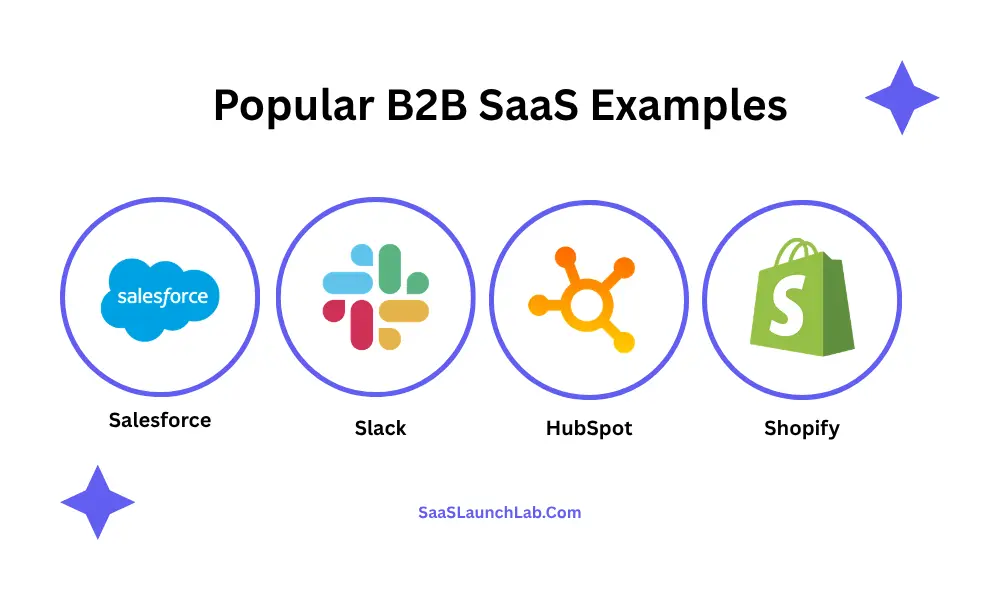
To understand B2B SaaS, it helps to look at popular tools that many businesses use daily. These examples illustrate how the model solves specific problems across different sectors.
| SaaS Tool | Primary Function | Industry |
|---|---|---|
| Salesforce | Customer Relationship Management (CRM) | Sales, Marketing |
| Slack | Team Communication & Collaboration | General Business |
| HubSpot | Marketing, Sales, and Service Automation | Marketing, Sales |
| Shopify | E-commerce Platform Management | Retail, E-commerce |
| Zoom | Video Conferencing & Webinars | General Business |
| Canva | Graphic Design & Visual Content Creation | Marketing, Design |
These tools are integrated into business processes and are critical for daily operations.
Learn About: Enterprise SaaS backend & SaaS Development Agency vs Freelancer
B2B SaaS vs B2C SaaS (What’s the Difference?)
This is one of the most common questions and is important for understanding the concept clearly.
| Feature | B2B SaaS | B2C SaaS |
|---|---|---|
| Target Users | Businesses, teams, organizations. | Individual consumers. |
| Primary Purpose | To improve business efficiency, operations, or profitability. | To entertain, connect, or provide personal convenience. |
| Pricing Model | Higher, tiered pricing based on users, features, or usage. Often involves enterprise contracts. | Lower, mass-market pricing (often freemium or flat-rate subscription). |
| Complexity | More feature-rich, with complex functionalities and integrations. | Simpler, easier-to-use interfaces for personal needs. |
| Sales Process | Often involves a dedicated sales team, demos, and longer sales cycles. | Self-service with minimal friction. |
Example:
- Slack (B2B) is designed to connect teams and streamline internal communication and workflow.
- Spotify (B2C) is designed for personal entertainment and music discovery.
Types of B2B SaaS
Not all SaaS products are the same. There are two main types:
Horizontal SaaS
These are broad, general-purpose tools that can be used across virtually any industry.
Example:
- Characteristics: Solve common, universal business problems.
- Examples: CRM (Salesforce), Project Management (Asana, Monday.com), Communication (Slack), Accounting (QuickBooks).
Vertical SaaS
These are niche solutions built for a specific industry, with features tailored to that industry’s unique needs.
Example:
- Characteristics: Highly specialized, often more expensive due to niche value.
- Examples: Healthcare management (Epic, Veeva), Real estate (Zillow for agents, MRI Software), Legal practice management (Clio).
Why Businesses Prefer B2B SaaS
The rapid growth of B2B SaaS is driven by clear, measurable benefits that offer a competitive advantage.
- Lower Upfront Costs: Eliminates the need for expensive on-premise hardware and perpetual software licenses. The subscription model turns a large capital expense (CapEx) into a manageable operating expense (OpEx).
- Scalability and Flexibility: Businesses can easily add or remove users, upgrade features, or scale down as needed, providing agility.
- Accessibility and Mobility: Employees can work from anywhere, using any device with an internet connection, facilitating remote and hybrid work models.
- Automatic, Seamless Updates: The provider manages all maintenance and updates, ensuring users always have the latest features and security patches without IT involvement.
- Faster Deployment: Implementation is typically much faster than traditional software, allowing businesses to realize value quickly.
The Impact of B2B SaaS (Data-Driven Insight):
- The global B2B SaaS market is projected to continue its strong growth, becoming a multi-trillion dollar industry.
- Companies are now allocating a significant portion of their IT budgets to SaaS applications, with some organizations using dozens of different tools.
Learn About: How Much Does It Cost to Add AI to a SaaS?
How B2B SaaS Companies Make Money
The B2B SaaS business model is built on generating recurring, predictable revenue. The main strategies include:
- Subscription-Based Pricing: The most common model. Recurring revenue via monthly or annual plans.
- Freemium Model: Offering a basic version for free to attract users, then converting them to a paid plan for advanced features (e.g., Slack, Zoom).
- Tiered Pricing: Providing different plans with varying features, storage, or user limits to cater to different business sizes (e.g., HubSpot’s Starter, Professional, and Enterprise plans).
- Enterprise Contracts: Custom pricing and feature sets for large organizations, involving dedicated customer support and service-level agreements (SLAs).
This creates a predictable and stable income.
The Future of B2B SaaS: Trends in 2026
The B2B SaaS landscape is constantly evolving. Key trends for 2026 include:
- AI-Powered SaaS: Integration of generative and predictive AI is becoming standard, offering automation, enhanced analytics, and personalized user experiences.
- Vertical AI Solutions: AI models specifically trained on niche industry data, creating “Vertical AI” applications that are even more powerful than generic horizontal tools.
- Hyper-Personalization: Software that adapts to individual user roles and workflows within a business.
- Focus on Data Privacy and Security: With increasing regulations, robust security features are a major differentiator and a top priority for buyers.
- Product-Led Growth (PLG): Strategies where the product itself is the primary driver of customer acquisition, conversion, and expansion.
Learn About: How Much Does SaaS Development Cost in 2026?
Challenges in B2B SaaS
While promising, the B2B SaaS model is not without its hurdles:
- Intense Market Competition: The barriers to entry are lower, leading to crowded markets. Standing out requires a strong value proposition and excellent execution.
- Customer Retention (Churn): Keeping customers subscribed is paramount. High churn can cripple a recurring revenue business.
- Data Security and Compliance: As a cloud provider, security is a non-negotiable and a major responsibility. This includes compliance with regulations like GDPR, CCPA, and HIPAA.
- Complex Customer Onboarding: Users need to realize value quickly. A complex or confusing onboarding process can lead to early abandonment.
- Sales and Marketing Efficiency: Customer Acquisition Costs (CAC) are high. It is critical to optimize marketing and sales funnels to ensure a good CAC-to-Lifetime Value (LTV) ratio.
Learn About: SaaS Audit Checklist Before Launch
Final Thoughts
B2B SaaS has fundamentally transformed the business landscape, enabling companies of all sizes to leverage powerful software without the traditional overhead. By understanding its core concepts, benefits, and future trends, you gain a significant advantage in today’s digital-first economy.
Whether you are a business owner seeking the right tools or an entrepreneur ready to build the next big platform, mastering B2B SaaS is essential for success in 2026 and beyond.
Learn About: Why Most SaaS MVPs Fail in the First 90 Days
FAQs
Ans. B2B SaaS is software that businesses use online through a subscription, instead of installing it on their own systems.
Ans. It works by hosting the software on the provider’s cloud servers. Businesses subscribe to access it, and the provider manages all updates, security, and infrastructure.
Ans. Common examples include Salesforce (CRM), Slack (team communication), HubSpot (marketing automation), and Zoom (video conferencing).
Ans. It helps businesses save money, reduce complexity, improve efficiency, and scale their operations using flexible, cloud-based solutions.
Ans. Yes, the model is highly profitable because it generates predictable, recurring revenue through subscriptions and has the potential for significant long-term customer value.
Ans. B2B SaaS is sold to businesses to improve their operations, while B2C SaaS is sold to individual consumers for personal use. They differ in target audience, pricing, sales process, and feature complexity.
Ready to Build or Scale Your SaaS Product?
Turning an idea into a successful SaaS product requires more than just coding. It demands a robust strategy, deep market understanding, and flawless execution.