

If you’ve ever typed “how much does it cost to build a SaaS product” into Google at 1 a.m., you already know the problem: every answer is either a vague sales pitch or a 40-page technical whitepaper written for engineers, not founders.
Learn About: SaaS Development Agency vs Freelancer
This guide is neither. It’s a practical walkthrough of SaaS product development written from the perspective of someone who has scoped, briefed, and shipped SaaS content and product pages for real software companies, not just read about it. You’ll learn what actually happens at each stage of the process, what it realistically costs in 2026, which architecture decisions come back to bite founders later, and how to avoid the mistakes that quietly kill otherwise good SaaS ideas.
No fluff, no “just build an MVP and iterate” one-liners without explanation. Let’s get into it.
Planning a SaaS build right now?
If you’re scoping a SaaS product and want a second opinion on your plan before you brief a dev team, message me on Upwork, and I’ll walk through it with you.
What Is SaaS Product Development, Really?
SaaS product development is the end-to-end process of designing, building, testing, and continuously improving a piece of cloud-hosted software that customers access on a subscription basis, rather than installing on their own machines. That definition sounds simple, but it hides the part that actually determines whether a product succeeds: SaaS isn’t a one-time build. It’s a living product that has to keep earning renewals every single billing cycle.
That single fact changes almost every decision in the development process. A traditional software project ends at delivery. A SaaS product’s development effectively never ends; it just shifts from “building the first version” to “maintaining and improving the version customers are actively paying for.” Teams that treat SaaS development as a one-off project, rather than an ongoing product discipline, tend to launch fine and then stall within the first year.
Learn About: How Much Does It Cost to Add AI to a SaaS?
Why the process matters more than the idea
Founders often assume the idea is the hard part. In practice, dozens of teams can have the same idea; the ones that win are the ones that run a disciplined SaaS development process validating demand before writing code, scoping a real MVP instead of a wish list, and building an architecture that doesn’t need to be rebuilt at 1,000 users. Process is what turns a good idea into a durable business.
The SaaS Product Development Lifecycle: 7 Stages
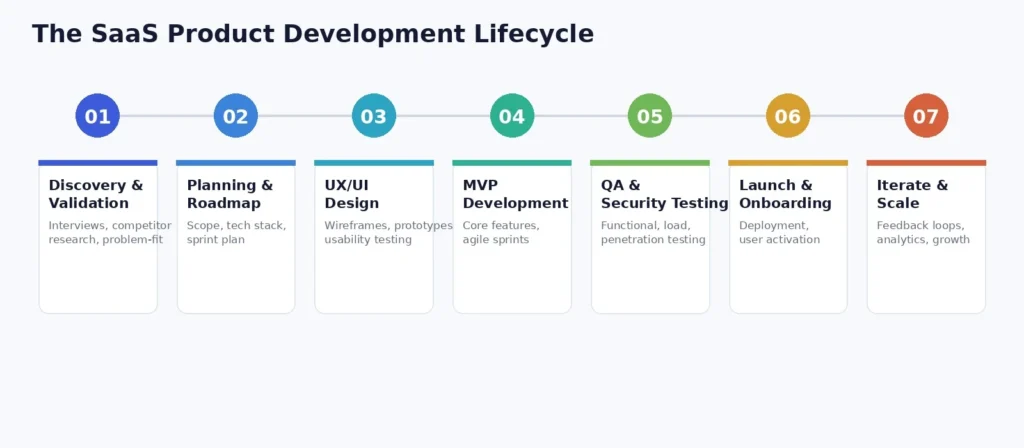
Every credible SaaS build, whether it’s a two-person startup or an enterprise platform, moves through the same seven stages. Skipping one doesn’t save time; it just moves the cost to later, when it’s more expensive to fix.
1. Discovery and validation
Before a single line of code is written, the goal is to confirm that the problem you’re solving is real, painful, and worth paying for. This means structured customer interviews (not casual chats ask about what people currently do and pay for, not what they’d theoretically like), competitor teardown, and a clear one-sentence value proposition. Skipping this stage is the single biggest reason SaaS products fail to find traction.
2. Planning and roadmap
Here you translate validated demand into scope: which features are must-haves for launch, which are “later,” what the tech stack will be, and how the team will work (most SaaS teams use two-week agile sprints). This is also where you decide your pricing model in draft form, since pricing affects architecture usage-based billing, for instance, needs metering built in from day one, not bolted on afterward.
3. UX/UI design
Wireframes and clickable prototypes get tested with real users before development starts, because it’s far cheaper to redesign a Figma screen than to rebuild a shipped feature. For B2B SaaS in particular, the interface has to work for both a first-time trial user and a power user running the tool daily those are different design problems, and good SaaS UX solves both.
4. MVP development
This is where the core, revenue-critical workflow gets built and only that. A common mistake is building five features at 60% quality instead of two features at 100% quality. A tight MVP that does one job extremely well converts trial users far better than a broad product that does many things adequately.
5. QA and security testing
Functional testing, load testing, and, increasingly, non-negotiable in 2026, security testing happen before any public launch. B2B buyers now routinely ask for security documentation during the sales process, so this stage isn’t just a technical checkbox; it protects your ability to close deals later.
6. Launch and onboarding
A technically solid product with a confusing first-run experience will still lose most of its trial users in the first session. Deployment should be paired with an onboarding flow that gets a new user to their first “aha moment” the point where they experience the product’s core value as fast as possible, ideally within minutes, not days.
7. Iterate and scale
Post-launch, the product enters a continuous loop: usage analytics and support tickets inform the next sprint, churn and activation metrics get tracked weekly, and the architecture gets revisited as load increases. This stage is permanent it’s the actual day-to-day of running a SaaS business.
Learn About: How to Scale a SaaS Business
How Much Does SaaS Product Development Cost in 2026?
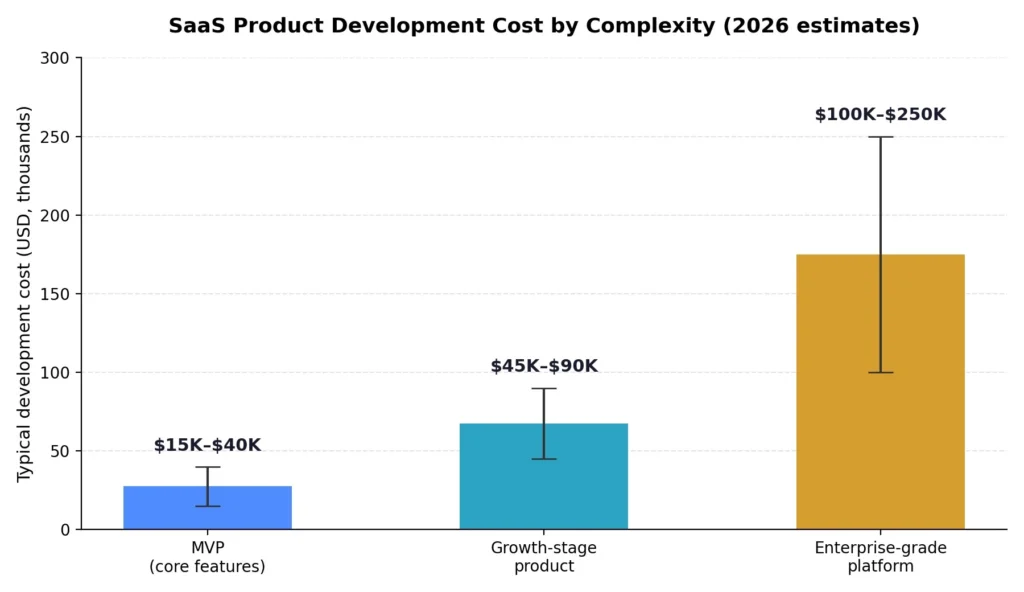
This is the question every founder actually wants answered, and the honest response is: it depends heavily on scope, not just on “SaaS” as a category. The table below reflects typical ranges seen across small-to-mid SaaS builds in 2026, based on complexity rather than industry.
| Product stage | Typical cost range (USD) | Typical timeline | What’s included |
| MVP (core features only) | $15,000 – $40,000 | 8 – 14 weeks | 1-2 core workflows, basic auth, single-tenant or light multi-tenant setup |
| Growth-stage product | $45,000 – $90,000 | 3 – 6 months | Full feature set, integrations, billing, role-based access, analytics |
| Enterprise-grade platform | $100,000 – $250,000+ | 6 – 12+ months | SOC 2-ready architecture, SSO, advanced permissions, high availability |
What actually drives the cost up
- Custom integrations (payment gateways, CRMs, industry-specific tools) rather than off-the-shelf ones
- Multi-tenant architecture with strict data isolation for enterprise clients
- Compliance requirements: SOC 2, HIPAA, GDPR, which add both engineering and audit costs
- Real-time features (live collaboration, notifications, dashboards) versus simple CRUD workflows
- The gap between “design that looks good in Figma” and “design that’s actually been built and tested”
Not sure which cost bracket your idea falls into?
I help founders turn a rough SaaS idea into a scoped brief a development team can actually quote accurately.
SaaS Architecture and Tech Stack: The Decisions You Can’t Easily Undo
Most technology choices in a SaaS build are reversible. A handful are not or are extremely expensive to reverse once you have paying customers. Getting these right early is worth more than any single feature.
Multi-tenancy from day one
Even if you launch with ten customers, design the database layer as if you’ll have ten thousand. Retrofitting tenant isolation into a single-tenant database later usually means a painful migration with real downtime risk. The safer default for most B2B SaaS products is schema-level or row-level tenant isolation built in from the first release.
Learn About: Multi-Tenant SaaS Architecture
API-first design
Building your product around a well-documented internal API rather than tightly coupling the frontend directly to the database makes it far easier to add a mobile app, a public API for customers, or new integrations later without a rewrite.
Modular monolith over premature microservices
Microservices get a lot of attention, but for most early-stage SaaS products they add operational complexity without a matching benefit. A well-structured modular monolith one codebase with clearly separated internal modules is usually faster to build, easier to debug, and cheaper to run, with the option to extract specific services later if a genuine scaling bottleneck appears.
Security and compliance as a purchasing decision
In 2026, especially when selling to businesses in regulated industries or across borders, security isn’t just an engineering concern it’s something prospective customers ask about before signing a contract. Data encryption in transit and at rest, role-based access control, audit logging, and a clear data retention policy should be part of the product from the start, not features added right before an enterprise deal falls through because they weren’t there.
Common SaaS Product Development Mistakes (and How to Avoid Them)
- Building before validating: writing code based on assumptions instead of confirmed customer pain leads to a polished product nobody needs.
- Scope creep during MVP development: every “just one more feature” delays launch and dilutes the core value proposition.
- Ignoring onboarding: acquiring a trial user and then losing them in a confusing first session wastes the entire acquisition cost.
- Treating security as a post-launch task: retrofitting compliance after enterprise prospects ask for it costs far more than building it in from the start.
- Choosing architecture based on what’s trendy rather than what the team can actually maintain at the current stage.
- No usage analytics from day one: without activation and retention data, every product decision after launch is a guess.
Learn About: Common SaaS SEO & Common UX Mistakes
In-House Team vs. Agency vs. Freelance Product Consultant
There’s no universally “right” answer here it depends on budget, timeline, and how much of the process you already understand.
- In-house team: best when SaaS is your core, long-term business and you can afford to hire before revenue justifies it. Highest control, highest fixed cost.
- Development agency: best for well-defined projects with a fixed scope and budget, where you want one point of accountability for delivery.
- Freelance specialists (SEO, content, product strategy, dev): best for founders who need specific expertise like scoping, technical SEO for the product’s marketing site, or content that supports the launch without committing to full-time hires.
Many successful SaaS launches actually blend all three: a small in-house core team, an agency or freelance developers for specific builds, and specialist freelancers for growth functions like SEO and content that a lean engineering team doesn’t have bandwidth for.
Learn About: How to Choose a SaaS Development Partner
Don’t Forget the Marketing Side: SEO for Your SaaS Product
A well-built product with no discoverability is still invisible. Once the core product is in good shape, the same rigor that goes into SaaS product development needs to go into the site that sells it: technical SEO, content that answers real buyer questions, and increasingly, structuring content so it’s understood correctly by AI Overviews and assistants like ChatGPT, Claude, Perplexity, and Gemini, not just traditional search rankings.
If you want a deeper breakdown of what that looks like in practice, the SaaS Launch Lab guide to launching and marketing a SaaS product is a useful next read, covering the go-to-market side that this article doesn’t get into.
Frequently Asked Questions
A focused MVP typically takes 8 to 14 weeks with a small, experienced team. A full growth-stage product with integrations and billing usually takes 3 to 6 months. Enterprise-grade platforms with compliance requirements often take 6 to 12 months or longer. Timelines stretch mainly due to scope creep, not the underlying technology.
Most MVPs cost between $15,000 and $40,000. A fuller growth-stage product typically runs $45,000 to $90,000, and enterprise-grade platforms with compliance and high-availability requirements can range from $100,000 to $250,000 or more. The biggest cost drivers are custom integrations, compliance requirements, and real-time features.
An MVP includes only the core workflow needed to prove the product solves a real problem, usually one or two features done exceptionally well. A full product adds the surrounding features (advanced permissions, integrations, reporting, billing tiers) that support long-term retention and expansion revenue once product-market fit is confirmed.
Agencies work well for fixed-scope projects with a defined budget and one point of accountability. Freelance specialists work well when you need specific expertise like a product strategist to scope the build, or an SEO specialist to prepare the marketing site without a full-time commitment. Many founders combine both.
There’s no single “best” stack the right choice depends on your team’s existing skills, expected scale, and budget. What matters more than the specific framework is the architecture pattern: API-first design, tenant isolation built in from the start, and a modular monolith rather than premature microservices for most early-stage products.
Key Takeaways
- SaaS product development is a continuous process, not a one-time project plan for iteration from day one.
- Validate demand before writing code; it’s the single biggest predictor of whether a SaaS product finds traction.
- A tight, well-built MVP beats a broad, half-finished product every time.
- Architecture decisions around multi-tenancy, APIs, and security are hard to reverse get them right early.
- Budget realistically: $15K–$40K for an MVP, scaling up based on integrations, compliance, and complexity.
Learn About: SaaS Audit Checklist Before Launch
Building a SaaS product that actually gets used and renewed comes down to disciplined process, not luck or a flashy feature list. If you’re at the planning stage and want a sounding board before you brief a development team or start writing your product’s marketing content, that’s exactly the kind of work I help with.
Ready to talk through your SaaS project?
I’ll help you scope the build, plan the launch content, and get the SEO foundation right from day one.