Choosing the right pricing model is one of the most important decisions when launching or growing a Software-as-a-Service (SaaS) business. Your pricing determines how customers pay, how your revenue grows, and whether your business can remain profitable as it scales.
A SaaS product may have excellent features, solve an important problem, and offer a great user experience. However, the wrong pricing structure can make it difficult to attract customers, convert free trials, and generate sustainable recurring revenue.
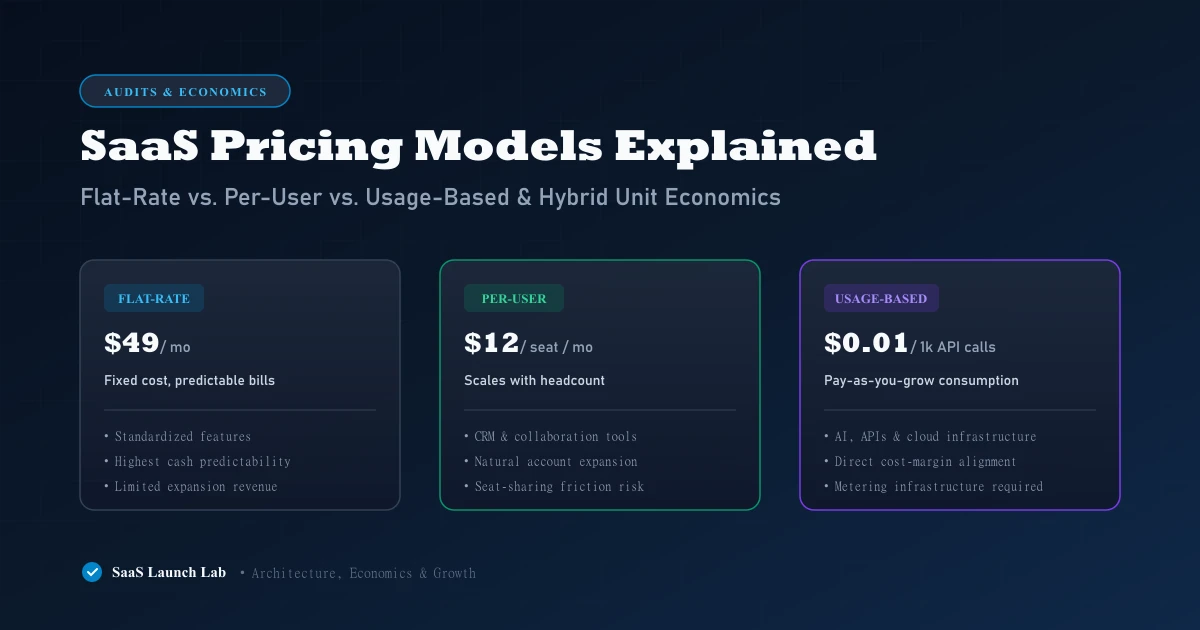
Three of the most common SaaS pricing models are flat-rate pricing, per-user pricing, and usage-based pricing. Each model works differently and suits different products, customers, and business objectives.
Some SaaS businesses also combine these approaches through hybrid pricing to create more flexible subscription plans.
In this guide, we explain how each SaaS pricing model works, compare its advantages and disadvantages, provide practical examples, and help you determine which pricing strategy is right for your business.
Quick Answer: Which SaaS Pricing Model Is Best?
There is no universally best SaaS pricing model. The right choice depends on your product's value, customer behavior, usage patterns, and operating costs.
Here is a quick comparison:
- Flat-rate pricing: Best for simple SaaS products offering a standardized set of features at a fixed subscription price.
- Per-user pricing: Best for collaboration tools, CRM platforms, project management software, and other products where value increases with the number of users.
- Usage-based pricing: Best for APIs, AI software, cloud infrastructure, and products where customers pay according to their consumption.
- Hybrid pricing: Best for SaaS companies combining a base subscription with additional user-based or consumption-based charges.
The ideal pricing model should make costs understandable for customers while allowing your business to increase revenue sustainably.
What Are SaaS Pricing Models?
A SaaS pricing model is the method a software company uses to charge customers for accessing its cloud-based software.
Unlike traditional software that customers purchase through a one-time license, Software-as-a-Service products generally operate through recurring subscriptions or consumption-based payments.
For example, a SaaS company might charge:
- $49 per month for access to its software.
- $15 per user per month for every employee using the platform.
- $0.01 for every 1,000 API requests.
- $99 per month plus additional charges when customers exceed their included usage limit.
These are different approaches to monetizing a SaaS product. It is also important to understand the difference between a pricing model and a pricing strategy:
- Pricing model: Explains how customers are charged.
- Pricing strategy: Explains how much a company charges and why that price makes sense for its customers and business objectives.
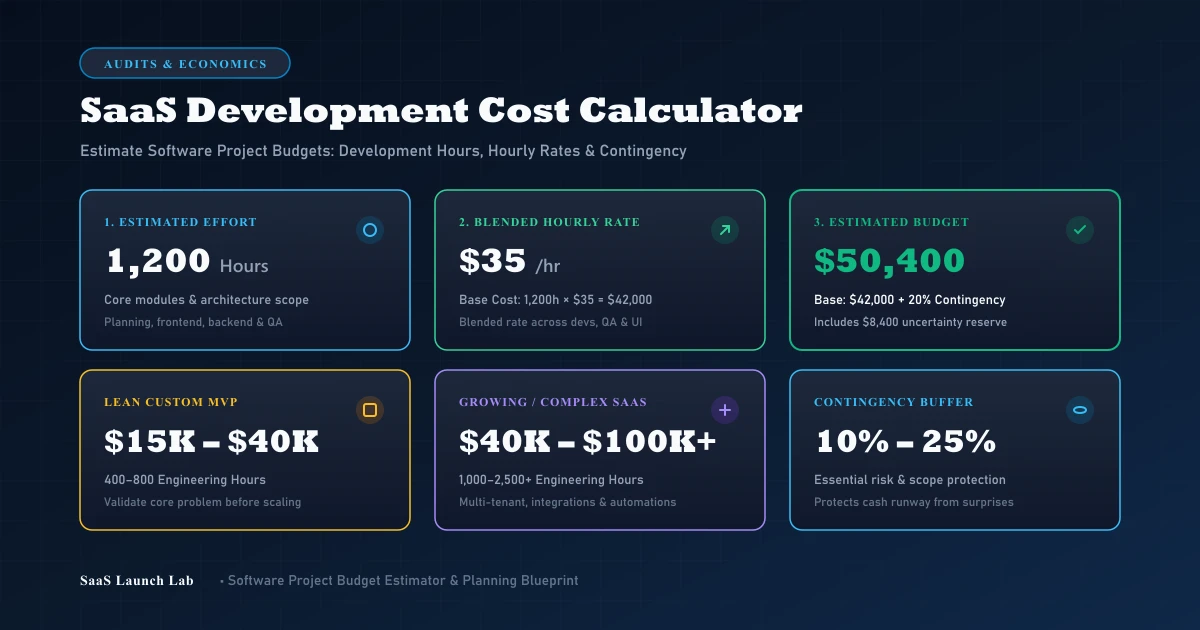
For example, a SaaS company can use per-user pricing as its model and value-based pricing as its pricing strategy. Understanding this difference helps founders build pricing structures that reflect both customer value and business economics alongside their overall SaaS development cost.
1. Flat-Rate SaaS Pricing Model
What Is Flat-Rate Pricing?
Flat-rate pricing is a SaaS subscription model in which customers pay one fixed price for access to a product, usually with a defined set of features.
The subscription price generally remains the same regardless of how many people use the software or how frequently they access it, subject to any stated usage restrictions.
For example, a project management SaaS might charge $49 per month for its complete software package. A company with two employees and another company with five employees could both pay $49 per month if the plan does not impose user limits.
How Does Flat-Rate Pricing Work?
The SaaS company creates one primary subscription package and charges eligible customers the same recurring amount. Customers can usually select monthly or annual billing, but the core package remains consistent.
| Subscription | Price | Included features |
|---|---|---|
| Monthly | $49/month | Complete standard package |
| Annual | $490/year | Same features, annual billing |
The annual option is a billing frequency, not a different pricing model.
Advantages of Flat-Rate Pricing
1. Simple purchasing decisions Customers know exactly how much they will pay each month. They do not need to calculate user counts or estimate consumption.
2. Easy to communicate A single subscription price makes it easier to communicate your offer through landing pages, advertisements, and sales conversations.
3. Predictable subscription revenue A fixed subscription makes revenue forecasting easier when customer retention and subscription numbers remain relatively stable.
4. Simpler billing infrastructure The company does not need sophisticated usage metering or complex seat-based billing calculations.
Disadvantages of Flat-Rate Pricing
1. Limited revenue expansion Customers using the software extensively may pay the same amount as customers using it occasionally.
2. Different customers receive different levels of value A small startup and a large organization might pay the same amount despite having significantly different requirements.
3. Infrastructure costs can increase If customers increase their consumption without additional charges, operating expenses may grow faster than revenue.
4. Limited pricing flexibility A single package may not adequately serve customers with different feature requirements, budgets, or business sizes.
When Should You Choose Flat-Rate Pricing?
Flat-rate pricing is suitable when:
- Your product offers a standardized set of features.
- Customer usage is relatively predictable.
- You want a simple purchasing experience.
- Your target audience consists primarily of small businesses or startups.
- Your infrastructure costs do not increase significantly with each additional customer action.
Practical example: A lightweight appointment scheduling application offering the same core functionality to most customers could use a fixed monthly subscription.
2. Per-User SaaS Pricing Model
What Is Per-User Pricing?
Per-user pricing is a subscription model in which customers pay according to the number of individuals who have access to or use the software. It is also commonly called per-seat pricing.
For example, a SaaS platform might charge $12 per user per month.
If a company has 10 users, its monthly subscription would be:
10 users × $12 = $120 per month.
If the company expands to 25 users, the subscription becomes:
25 users × $12 = $300 per month.
This model allows SaaS revenue to grow as customers add more employees or team members.
How Does Per-User Pricing Work?
The software provider defines a price for each user or seat. Customers select the number of seats they need and pay according to that quantity. Some SaaS platforms charge for every invited user, while others charge only for active users or specific types of seats. The billing rules should be clearly explained to customers.
| Number of users | Price per user | Monthly cost |
|---|---|---|
| 5 | $12 | $60 |
| 10 | $12 | $120 |
| 25 | $12 | $300 |
| 50 | $12 | $600 |
| 100 | $12 | $1,200 |
Advantages of Per-User Pricing
1. Revenue grows with customer teams As customers hire more employees and expand software access, subscription revenue can increase naturally.
2. Easy to calculate Customers can estimate subscription costs by multiplying the number of users by the price per seat.
3. Suitable for collaboration software Project management, CRM, communication, and team productivity platforms often provide value to multiple employees.
4. Supports customer expansion Businesses can start with a small team and increase their subscription as their requirements grow.
Disadvantages of Per-User Pricing
1. Customers may avoid adding users Some businesses limit employee access to reduce subscription expenses.
2. It can discourage collaboration When every additional user increases costs, employees may share accounts or avoid inviting colleagues.
3. Revenue may not reflect actual product value A customer with five highly active users might receive more value than a customer with 50 occasional users.
4. It may not suit automated products Software that delivers value through background processes, APIs, or automation may not have a meaningful relationship between value and user count.
When Should You Choose Per-User Pricing?
Per-user pricing is suitable when:
- Your software is designed for teams.
- Each employee receives individual value from the product.
- User access is an important part of your product's value.
- Customer organizations naturally expand their software seats.
- Your costs do not increase disproportionately with individual users.
Practical example: A CRM platform that helps sales representatives manage leads, contacts, and customer relationships can charge according to the number of sales representatives using the software.
3. Usage-Based SaaS Pricing Model
What Is Usage-Based Pricing?
Usage-based pricing is a SaaS monetization model in which customers pay according to how much of a product or service they consume. Instead of charging a fixed amount for every user, the company measures specific usage activities and calculates the bill accordingly.
This model is also known as consumption-based pricing or pay-as-you-go pricing.
Common usage metrics include:
- API requests.
- Data storage.
- Computing hours.
- Emails sent.
- AI tokens processed.
- Transactions completed.
- Minutes of video processed.
- Bandwidth consumed.
For example, an API provider might charge $0.01 for every 1,000 API requests. A customer processing 100,000 requests would pay:
100,000 ÷ 1,000 × $0.01 = $1.00.
The actual pricing metric and calculation must be clearly defined in the product's pricing terms.
How Does Usage-Based Pricing Work?
The SaaS company identifies a measurable activity that represents product consumption or customer value. It then establishes a price for each unit of usage. The software tracks customer consumption during the billing period and calculates the final invoice.
| Monthly API requests | Price per 1,000 requests | Monthly cost |
|---|---|---|
| 10,000 | $0.01 | $0.10 |
| 100,000 | $0.01 | $1.00 |
| 500,000 | $0.01 | $5.00 |
| 1,000,000 | $0.01 | $10.00 |
These figures are illustrative rather than market benchmarks.
Advantages of Usage-Based Pricing
1. Customers pay according to consumption Customers can start with smaller bills and pay more as their requirements increase.
2. Revenue can grow with product adoption When customers use more of your software, revenue can increase without requiring them to purchase additional user seats.
3. Lower purchasing barriers Customers may be more willing to test a product when they only pay for actual consumption.
4. Better alignment between costs and revenue For products with usage-related infrastructure costs, consumption-based billing can help the company recover costs as usage grows.
5. Suitable for AI and infrastructure products AI APIs, cloud platforms, data processing tools, and developer infrastructure frequently have measurable consumption units.
Disadvantages of Usage-Based Pricing
1. Unpredictable monthly bills Customers may struggle to estimate expenses when consumption changes frequently.
2. More complicated billing infrastructure The company needs accurate usage tracking, metering, billing calculations, and invoice reporting. Modern engineering teams often integrate dedicated billing engines like Stripe Billing to reliably track meters and automate complex invoicing cycles.
3. Unexpected cost increases A sudden increase in consumption can result in a surprisingly high invoice if customers do not receive appropriate usage notifications.
4. Revenue forecasting can be difficult Customer consumption may fluctuate from month to month, making revenue predictions more complicated.
When Should You Choose Usage-Based Pricing?
Consider usage-based pricing when:
- Customers consume different quantities of your product.
- Your infrastructure costs increase with consumption.
- You can measure usage accurately.
- Customers receive more value as consumption increases.
- You can provide transparent usage reports and cost estimates.
Practical example: An AI writing API that charges according to tokens processed can use usage-based pricing because consumption is measurable and often relates to infrastructure costs.
Flat-Rate vs Per-User vs Usage-Based Pricing: Comparison
The following table summarizes the main differences between the three pricing models:
| Comparison | Flat-rate | Per-user | Usage-based |
|---|---|---|---|
| Billing method | Fixed subscription | Number of users | Actual consumption |
| Cost predictability | High | High if seats remain stable | Variable |
| Revenue expansion | Limited without upgrades | More users | More consumption |
| Billing complexity | Low | Medium | High |
| Customer entry barrier | Usually simple | Depends on seat price | Can be low |
| Best suited for | Standardized products | Team software | APIs, AI, infrastructure |
| Main challenge | Revenue expansion | User adoption barriers | Unpredictable bills |
Which Model Offers the Best Revenue Potential?
The answer depends on how customers receive value from your product:
- Flat-rate pricing can support stable recurring subscriptions but may limit expansion revenue.
- Per-user pricing can increase revenue as customer organizations grow.
- Usage-based pricing can increase revenue as customer consumption increases, but it also creates billing and forecasting challenges.
A SaaS founder should not select a pricing model simply because competitors use it. The model should reflect the product's value, customer behavior, and cost structure.
4. Hybrid SaaS Pricing Model: Combining Different Approaches
Many SaaS products do not rely on just one pricing model. A hybrid pricing model combines two or more approaches, such as a fixed monthly subscription with per-user charges or usage-based fees.
For example, a business analytics platform could charge:
- $49 monthly base subscription.
- $10 per additional user.
- Additional charges for data processing above the included limit.
This approach combines predictable recurring revenue with opportunities to monetize additional usage.
Common Hybrid Pricing Examples
- Flat-rate + usage-based: Customers pay a fixed subscription that includes a limited amount of consumption. Additional usage is charged separately.
- Per-user + usage-based: Customers pay for each seat and additional charges when they exceed defined usage limits.
- Tiered + per-user: Customers select a feature package and pay according to the number of seats included or purchased.
Advantages of Hybrid Pricing
- Multiple revenue expansion opportunities.
- Flexibility for different customer segments.
- Better alignment between subscription revenue and operating costs.
- Ability to offer an affordable entry-level package.
Disadvantages of Hybrid Pricing
- More complicated pricing pages.
- Customers may struggle to estimate total costs.
- Billing and subscription management become more demanding.
- Poorly communicated limits can create customer frustration.
Practical recommendation: Start with a simple structure. Add another pricing dimension only when customer behavior, product economics, or market feedback justifies it.
5. How to Choose the Right SaaS Pricing Model
Selecting the right pricing model requires understanding your customers, product, operating costs, and long-term business objectives. Follow these steps before publishing your SaaS pricing page:
Step 1: Understand How Customers Receive Value
Ask yourself:
- Do customers receive value from having more team members?
- Does product value increase with the amount of consumption?
- Do most customers need the same features?
- Are there significant differences between small and enterprise customers?
Your pricing metric should reflect something customers understand as valuable.
Step 2: Analyze Your SaaS Operating Costs
Calculate the costs involved in serving each customer. Consider:
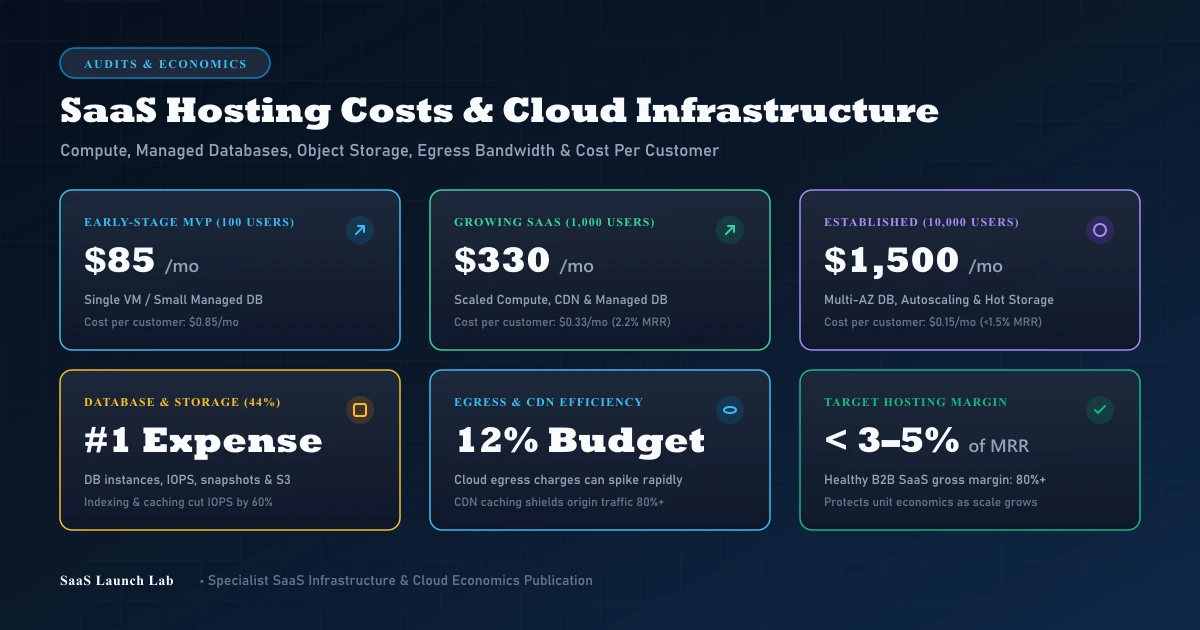
- Cloud hosting and infrastructure.
- Database and storage expenses.
- Third-party API costs.
- AI model consumption.
- Customer support.
- Payment processing.
- Maintenance and development.
For AI products specifically, variable token costs and inference latency require careful unit economics modeling—see our detailed guide on the cost of adding AI to SaaS to calculate inference margins. Furthermore, understanding how each platform capability contributes to operating overhead is critical when pricing; our analysis of SaaS platform development cost per feature breaks down implementation and maintenance cost per component.
Step 3: Research Your Competitors
Study how similar SaaS companies charge customers. Compare:
- Monthly and annual subscription prices.
- Included features.
- User or seat limits.
- Usage allowances.
- Additional charges.
- Free trials and free plans.
- Enterprise pricing options.
Do not copy competitor prices without understanding their product positioning, target customers, and operating costs.
Step 4: Consider Customer Purchasing Behavior
Your pricing should match how customers prefer to purchase software:
- Small businesses may prefer simple, predictable subscriptions.
- Growing teams may accept per-seat pricing when collaboration is valuable.
- Developers may prefer consumption-based pricing for APIs.
- Enterprise customers may require custom contracts and volume-based agreements.
For founders building enterprise solutions, pricing dynamics differ significantly from consumer software—explore our foundation guide on what is B2B SaaS to align pricing with procurement cycles.
Step 5: Test Your Pricing Before Scaling
Pricing should be tested using real customer feedback and business data. Monitor:
- Free-to-paid conversion rate.
- Trial-to-paid conversion rate.
- Average revenue per account (ARPA).
- Monthly recurring revenue (MRR).
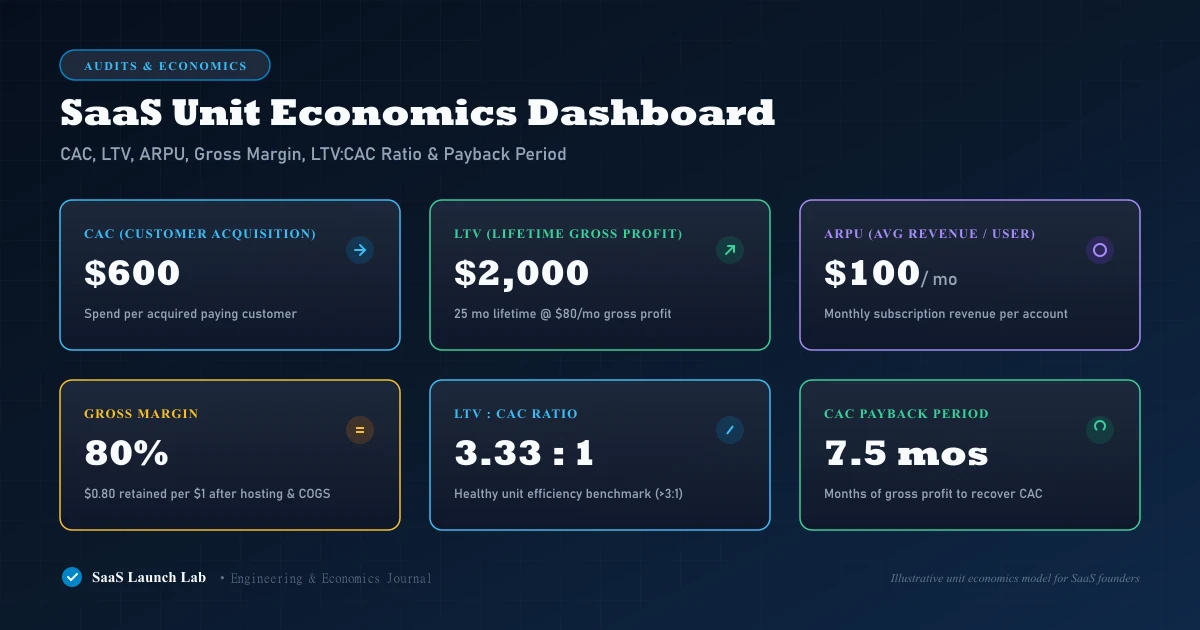
- Customer acquisition cost (CAC).
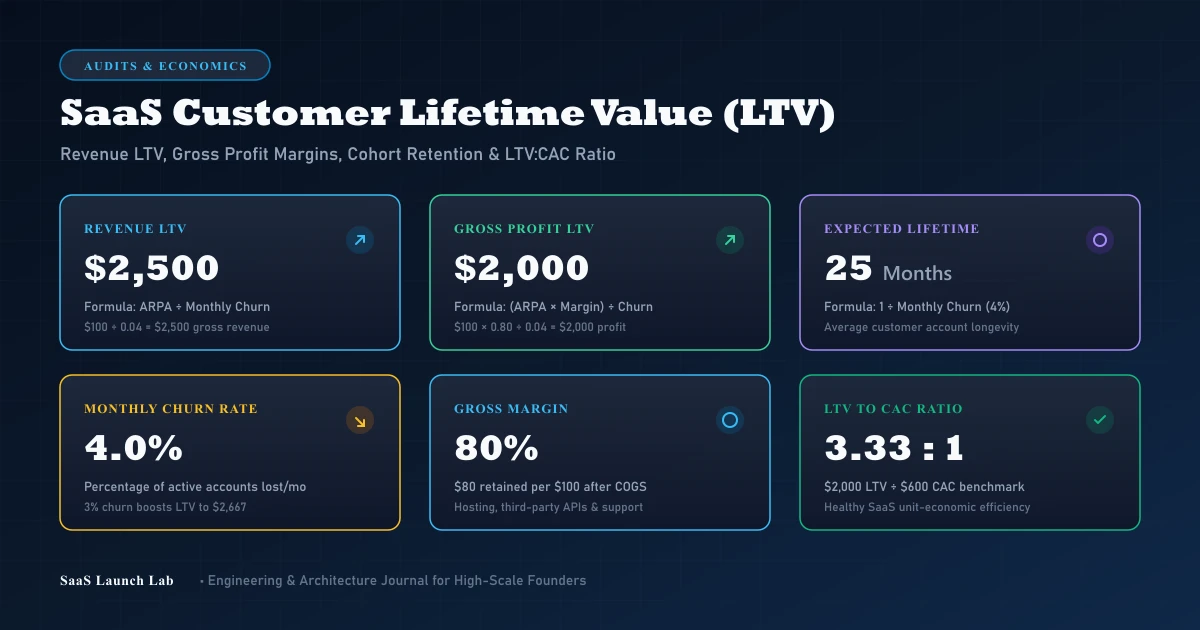
- Customer lifetime value (LTV).
- Gross margin.
- Customer churn.
- Expansion revenue.
Tracking customer retention and account health is vital after rollout; proactive onboarding and support play a crucial role, as explored in our guide to customer success in SaaS. Use these metrics to understand whether your pricing model attracts the right customers and supports sustainable growth.
6. SaaS Pricing Example: How the Same Product Can Use Different Models
Imagine you are launching a cloud-based project management SaaS. You want to charge customers for task management, team collaboration, reporting, and project tracking. You could monetize the same product in three different ways:
Option A: Flat-Rate Pricing
Charge every customer $49 per month. A company with five users pays $49, and a company with 20 users also pays $49, assuming both fit the same package.
Business consideration: This is easy to sell, but larger customers may receive substantially more value without contributing additional subscription revenue.
Option B: Per-User Pricing
Charge $10 per user per month.
| Customer | Users | Monthly revenue |
|---|---|---|
| Company A | 5 | $50 |
| Company B | 10 | $100 |
| Company C | 20 | $200 |
| Company D | 50 | $500 |
Business consideration: Revenue expands as customers add team members, but some organizations may restrict access to control costs.
Option C: Usage-Based Pricing
Charge $0.05 for every 100 tasks processed.
| Customer | Tasks processed | Monthly revenue |
|---|---|---|
| Company A | 1,000 | $0.50 |
| Company B | 10,000 | $5.00 |
| Company C | 50,000 | $25.00 |
| Company D | 100,000 | $50.00 |
Business consideration: Customers pay according to activity, but the company must ensure that task volume is a meaningful measure of customer value.
These examples are hypothetical and use arbitrary prices to demonstrate the calculations. They are not recommended market prices. The important lesson is that the same SaaS product can produce different revenue outcomes depending on its pricing structure.
7. Common SaaS Pricing Mistakes to Avoid
Even a well-developed SaaS product can struggle because of poor pricing decisions. Here are some common mistakes founders should avoid:
1. Copying Competitor Pricing Your competitor's cost structure, customer segment, and product value may be different. Copying their prices without research can damage your margins.
2. Making Pricing Too Complicated Too many plans, limits, add-ons, and hidden charges can make purchasing decisions difficult. Keep your pricing page straightforward.
3. Ignoring Infrastructure Costs A low subscription price may attract customers, but high usage and infrastructure expenses can make the business unprofitable.
4. Charging for the Wrong Metric If you charge per user when customers receive value from API consumption, your pricing may not reflect how they use the product. Choose a metric that connects naturally with customer value.
5. Not Offering Annual Billing Annual subscriptions can improve cash flow and reduce the frequency of renewal decisions. However, discounts should be calculated carefully to protect margins.
6. Changing Prices Without Communicating Clearly Unexpected pricing changes can reduce customer trust. Communicate changes transparently and explain how existing subscriptions will be affected.
7. Ignoring Customer Feedback Your initial pricing assumptions may not match real purchasing behavior. Review customer objections, cancellation reasons, and upgrade patterns regularly.
8. Best Practices for Building a Successful SaaS Pricing Strategy
A good pricing strategy should balance customer affordability, perceived value, and business profitability. Follow these practices:
- Make the value proposition clear: Explain what customers receive for their subscription.
- Use understandable pricing metrics: Avoid billing units that customers cannot easily measure.
- Provide transparent usage limits: Display included allowances and additional charges.
- Offer suitable plans: Address different customer requirements without creating unnecessary complexity.
- Monitor unit economics: Ensure that customer revenue can support infrastructure and service costs. Model your customer acquisition costs and payback thresholds using our comprehensive guide to SaaS unit economics. Before taking a new pricing structure live, review our SaaS audit checklist before launch to verify that metering, webhook handling, and margin safeguards are fully tested. You can also explore our broader coverage in SaaS Audits & Economics.
- Use customer research: Conduct interviews and analyze purchasing objections.
- Review pricing regularly: Reassess your pricing as the product and market evolve.
- Test changes carefully: Measure the impact on conversion, revenue, churn, and customer satisfaction.
Remember that pricing is not a one-time decision. It should evolve as your product, customers, and business economics change.
Frequently Asked Questions About SaaS Pricing Models
What are the three main SaaS pricing models? The three common SaaS pricing models are flat-rate pricing, per-user pricing, and usage-based pricing. Flat-rate charges a fixed subscription, per-user charges according to the number of seats, and usage-based pricing charges according to actual consumption.
Is flat-rate pricing better than per-user pricing? Neither model is universally better. Flat-rate pricing works well for standardized products with similar customer requirements, while per-user pricing is often suitable for team-based software where each additional user receives value.
What is the difference between per-user and usage-based pricing? Per-user pricing calculates subscription costs according to the number of users or seats. Usage-based pricing calculates costs according to measurable consumption, such as API requests, storage, transactions, or AI tokens.
Is usage-based pricing good for SaaS startups? Usage-based pricing can work well for startups offering APIs, AI services, and infrastructure products. It can reduce initial purchasing barriers, but founders need reliable usage tracking, transparent billing, and cost controls.
What is a hybrid SaaS pricing model? A hybrid SaaS pricing model combines different billing methods. For example, a company might charge a fixed monthly subscription with additional per-user or usage-based fees.
How do I calculate the right price for my SaaS product? Start by calculating your operating costs, understanding customer value, researching competitors, and evaluating your required gross margins. Then test pricing with real customers and monitor conversion, revenue, retention, and profitability.
Can a SaaS company change its pricing model? Yes. A SaaS company can move from flat-rate to per-user, usage-based, tiered, or hybrid pricing as its product and customer base evolve. However, changes should be tested and communicated clearly to existing customers.
What is the best pricing model for B2B SaaS? The best model depends on the product and customer segment. Per-user pricing can suit team collaboration products, flat-rate pricing can suit standardized business tools, and usage-based pricing can suit APIs and infrastructure services. Hybrid pricing can work when multiple value metrics matter.
What is value-based SaaS pricing? Value-based pricing is a strategy in which a SaaS company sets prices according to the perceived or measurable value customers receive rather than simply adding a markup to operating costs. It can be applied alongside flat-rate, per-user, or usage-based models.
Should SaaS startups offer free trials? Free trials can help customers experience a product before purchasing. Whether to offer a free trial, freemium plan, or paid demonstration depends on product complexity, customer acquisition costs, and the time required for customers to experience value.
Final Thoughts
Choosing between flat-rate, per-user, and usage-based pricing is not simply a decision about how much money to charge customers. It is a decision about how your SaaS business creates, delivers, and captures value.
Flat-rate pricing offers simplicity and predictable subscriptions. Per-user pricing connects revenue with team growth. Usage-based pricing connects revenue with product consumption. Hybrid pricing combines multiple approaches when a single metric is not enough.
Before choosing, understand your customers, calculate your operating costs, identify the value metric that matters, and test your assumptions. The best SaaS pricing model is the one customers understand, consider fair, and are willing to pay for while allowing your business to grow sustainably.
About SaaS Launch Lab
SaaS Launch Lab publishes educational resources, practical guides, and architectural blueprints to help entrepreneurs, founders, and engineering teams build, launch, and scale high-growth software products. Have questions regarding your unit economics or billing architecture? Send an inquiry directly to our editorial desk.